How to choose the right size of framed & mounted photo print for your space
Torn between 60×40 cm and 70×50 cm? You’re not alone. Getting scale right is the difference between a picture that sings and one that looks lost. This practical guide walks you through measuring your wall, applying proportion rules (including the 4/7 rule), and understanding how mounts and frame depths affect the overall size you see on the wall. All examples use the real specifications of Utterly Printable’s Framed & Mounted Photo Prints: 12-colour archival printing on 210gsm smooth-matte paper, a 1.4 mm mount, solid-wood frames (black, white or natural) that are 2.5 cm wide/deep, and lightweight, shatterproof acrylic glazing. Sizes range from 30×20 cm up to 70×50 cm, and everything arrives ready to hang in around three working days across the UK.
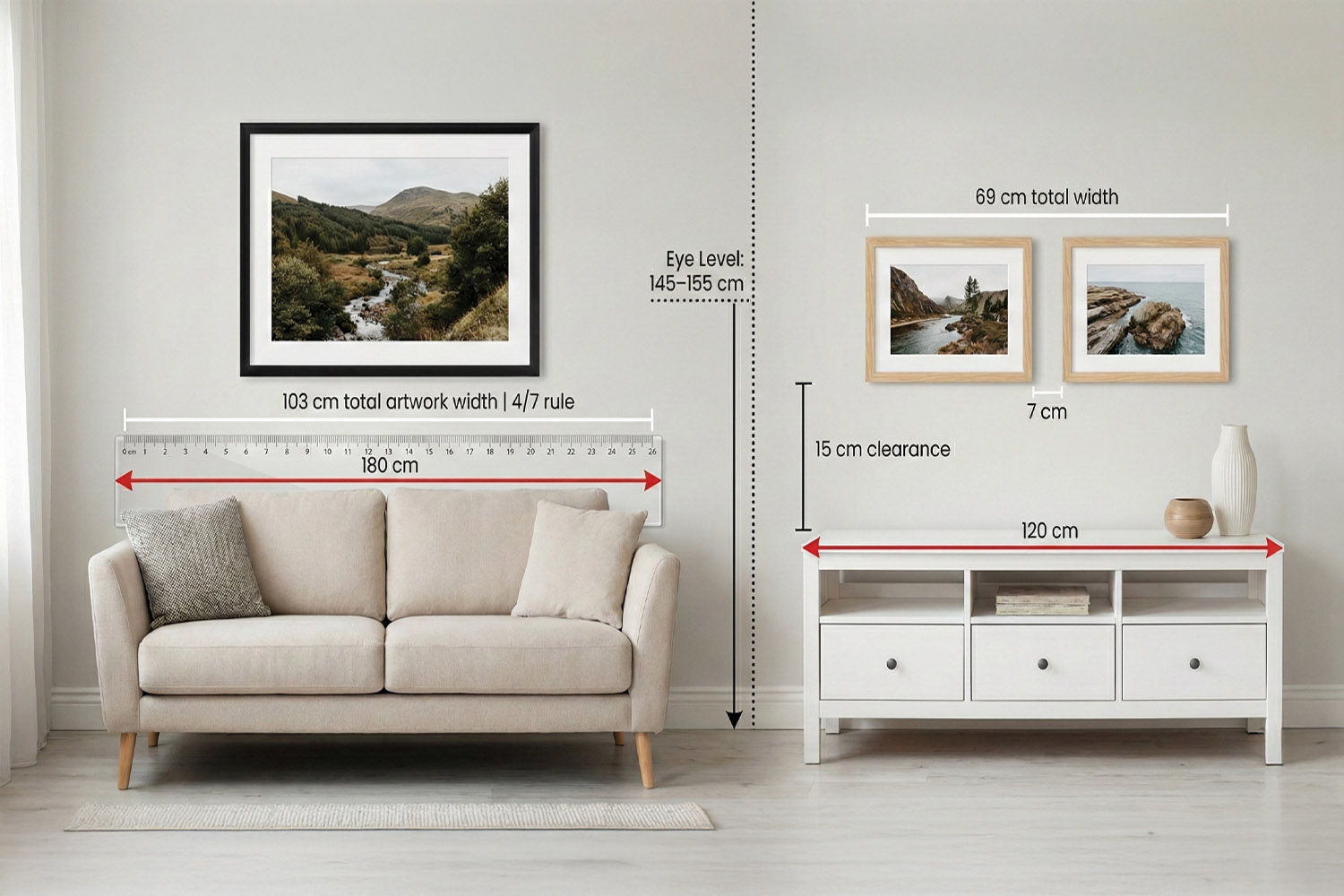
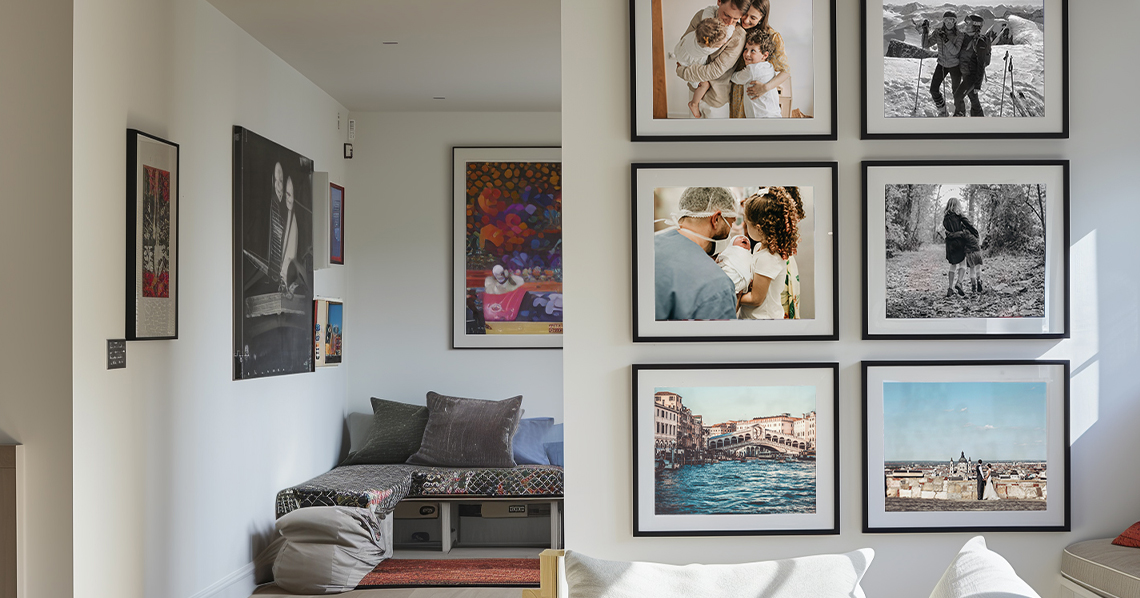
Framed and mounted prints arranged in a modern living room, demonstrating recommended sizing and hanging heights for stylish wall decor.
Start with the space: measure, proportion and sight-lines
1) Measure your available width.
If you’re hanging above furniture, measure the furniture width. If it’s a bare wall, measure the clear span you’d reasonably like to fill (avoiding light switches, radiators and doors).
2) Apply a simple proportion rule.
A dependable guideline is the 4/7 rule: aim for wall art that’s roughly four-sevenths (around 57%) of the furniture or wall width.
- Example: 180 cm sofa 4/7 = roughly 103 cm of total artwork width.
- Example: 120 cm console 4/7 = roughly 69 cm total width.
3) Decide on one piece or a set.
If a single framed print won’t reach your target width, consider a pair or trio. Two frames with a 5–8 cm gap often look deliberate and calm. A neat gallery row can outperform one oversized piece in narrow rooms.
4) Fix your sightline.
For most rooms, a comfortable centre height is 145–155 cm from the floor (average eye level). Above furniture, leave 10–20 cm clearance from the top of the furniture to the bottom of the frame.
5) Factor in the frame and mount, not just the print.
With Utterly Printable’s mounted frames, the visible mount adds a crisp border and the frame itself adds 2.5 cm per side. That extra “negative space” increases the overall footprint and visual presence—useful when you want the art to read larger without enlarging the photo itself.
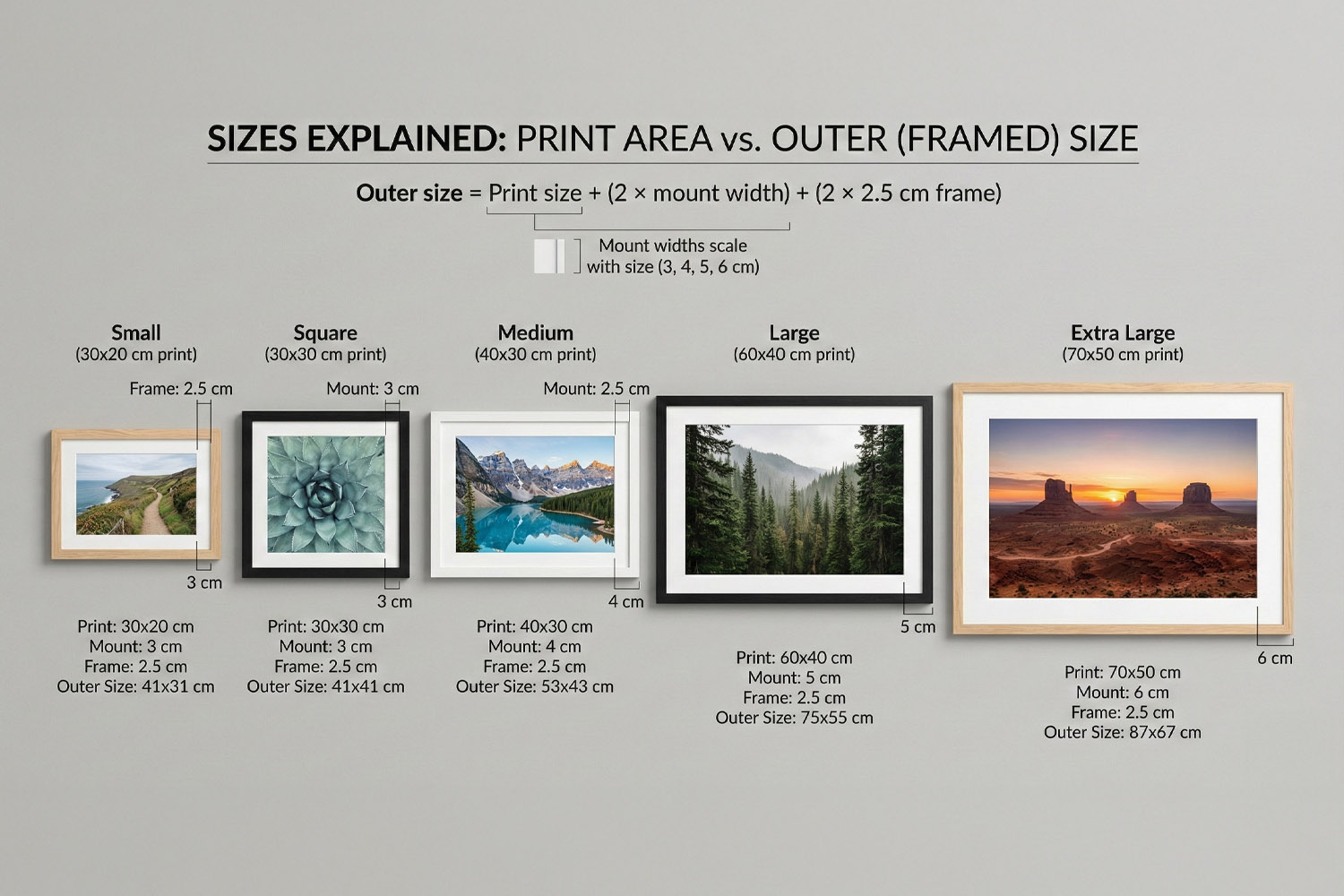
Framed and Mounted Prints size comparison chart with clear measurements for each print, helping you choose the perfect fit for your space
Sizes explained: print area vs. outer (framed) size
Below are the five print formats offered for Framed & Mounted Photo Prints, with approximate outer dimensions once the mount and frame are included. Mount widths scale with size (about 3 cm on small, 4 cm medium, 5 cm large, 6 cm XL), and frame width is 2.5 cm on each side. Figures below assume landscape orientation where relevant; portrait simply swaps width/height.
How to read this:
Outer size = Print size + (2 × mount width) + (2 × 2.5 cm frame)
- 30×20 cm (Small) = 41×31 cm
(30 + 6 + 5 by 20 + 6 + 5). Great for hallways, small alcoves, layered shelves. - 30×30 cm (Square) = 41×41 cm
Perfect for grid arrangements or to punctuate a gallery wall. - 40×30 cm (Medium) = 53×43 cm
A versatile “go-anywhere” size for above consoles or in pairs over a sofa. - 60×40 cm (Large) = 75×55 cm
Strong single focus for midsized walls; often the sweet spot for bedrooms. - 70×50 cm (Extra Large) = 87×67 cm
Statement piece for larger living rooms or dining spaces.
60×40 cm vs 70×50 cm—how to choose?
Compare your target width (from the 4/7 rule) to the outer width above:
- 180 cm sofa target is equally roughly to 103 cm. A single 70×50 cm (outer ~87 cm) may look slightly modest; a pair of 40×30 cm(53 cm each) with a 5–8 cm gap (total 111–114 cm) feels purposeful.
- 140 cm bedhead target roughly 80 cm. A 60×40 cm (outer ~75 cm) sits comfortably; two 30×30 cm pieces (41 cm each) can also work as calm symmetry.
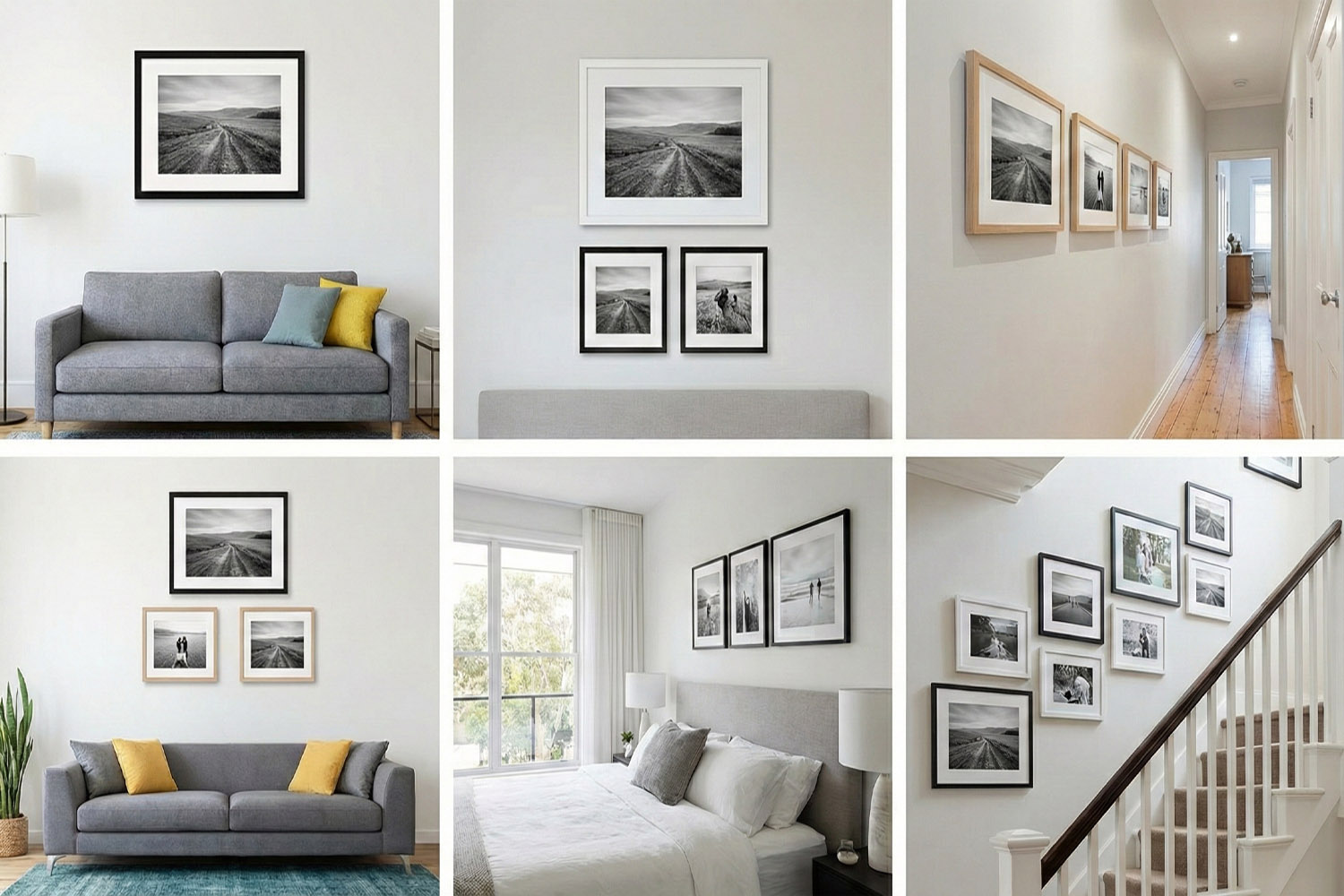
Framed and mounted prints shown in different rooms, offering inspiration for stylish wall art arrangements throughout your home.
Room-by-room sizing tips (with real-world examples)
Living room: above a sofa
- Width: Target four-sevenths of the sofa width. For 200 cm, that’s ~114 cm.
- Single vs pair: If you prefer one focus, the 70×50 cm framed piece (outer ~87 cm) keeps things airy; if you want more presence, use a pair of 40×30 cm (outer ~53 cm each) with a 6 cm gap (total ~112 cm).
- Mount effect: Larger mounts (5–6 cm on bigger frames) add breathing space and help busy photos feel elegant rather than overwhelming.
- Finish & safety: The lightweight acrylic glazing keeps reflections low and makes larger frames safer and easier to hang.
Bedroom: above the bed
- Double (135–140 cm headboard): A single 60×40 cm (~75 cm outer) balances well without crowding.
- King (150–160 cm): Use 70×50 cm (~87 cm outer) for a confident focal point, or a pair of 30×30 cm (~41 cm outer each) for symmetry.
- Height: Keep the frame bottom 12–18 cm above the headboard and centre at ~150 cm from floor to avoid looming.
Hallways & narrow walls
- Hallways love linear rhythm. Use a series of 30×20 cm (~41 cm outer) spaced 5–8 cm apart at a consistent centre height.
- For a short stub wall, a 30×30 cm square can be the perfect exclamation mark.
Dining area or over a console
- For a 120 cm console, target ~69 cm. A 40×30 cm (~53 cm outer) feels neat; step up to 60×40 cm (~75 cm), if you want more drama.
- Mix formats around a consistent mount colour and frame finish for cohesion.
Staircase gallery
- Follow the incline: keep the centres aligned to a line parallel with the handrail.
- Use lighter pieces (30×20 cm or 40×30 cm). Acrylic glazing is shatter-resistant and lighter than glass—ideal for high-traffic zones and stairwells.
Building a gallery wall
- Start with one anchor (e.g., a 60×40 cm). Add 30×20 cm or 30×30 cm around it, keeping 5–8 cm between frames.
- Consistent mounts tie mixed photos together. Utterly Printable’s mounts scale by size (approx. 3/4/5/6 cm), so the visual margins feel deliberate across a multi-size arrangement.
- Want a flatter, more minimal look? Complement with simple framed prints (no mount) for contrast, or use personalised photo posters for big statement areas where you don’t need the mount’s border. For soft edges in echoey spaces, stretch canvas photo prints are a warm alternative.
Orientation & cropping
- Match the frame orientation to the photo’s natural composition; avoid excessive cropping to “force” a fit.
- The online editor supports single images and multi-photo collages, handy for storytelling sets within one frame.
Practicalities: weight, safety & hanging
- Frames are solid wood yet manageable thanks to lightweight, shatterproof acrylic glazing—easier and safer than glass, especially in nurseries, staircases and rental properties.
- Each piece arrives assembled, with fixings included, so you can plan your hanging height in advance and install with minimal fuss.
- Standard dispatch is around three working days within the UK.
Quick checklist
- Measure width; apply the 4/7 rule.
- Check outer frame size, not just the print.
- Choose one statement or a deliberate set.
- Keep centres ~145–155 cm high; gaps 5–8 cm.
- Pick frame colour (black, white, natural) to suit room contrasts.
To explore the full range of sizes and finishes, see our Framed & Mounted Photo Prints. If you decide a mount-less look is better for your gallery wall, browse our simple framed prints, or go big with personalised photo posters. For texture and warmth, consider stretch canvas photo prints as a complementary option.

Framed & mounted print size FAQs
Short, clear answers to the questions we hear most—from sofa spacing to staircases—using the exact specifications of our frames and mounts.
Aim for roughly 4/7 of the sofa width. For 180 cm, target ~103 cm. A single 70×50 cm (outer ~87 cm) keeps things airy; a pair of 40×30 cm (outer ~53 cm each, 5–8 cm gap) fills the width more decisively.
Check your target width and the outer sizes: ~75 cm vs ~87 cm. On medium walls or above a double bed, 60×40 cm is balanced. On wider walls or king beds, 70×50 cm reads as a confident focal point.
Use a 145–155 cm centre height for most rooms. Over furniture, keep 10–20 cm from the top of the furniture to the bottom of the frame.
Yes. The mount (about 3–6 cm per side, scaling with size) plus the 2.5 cm frame border increases the overall footprint. If you’re tight on space, consider a smaller print—the mount keeps presence without overpowering.
The glazing is lightweight, shatterproof acrylic, not glass, making larger frames easier to hang and safer in high-traffic areas like stairs and hallways.
Related products for different looks:
Try simple framed prints for a mount-less, slim profile, personalised photo posters for big, graphic statements, and stretch canvas photo prints for softer, textured finishes. And when you’re ready to create, head to Framed & Mounted Photo Prints to design and preview your piece.
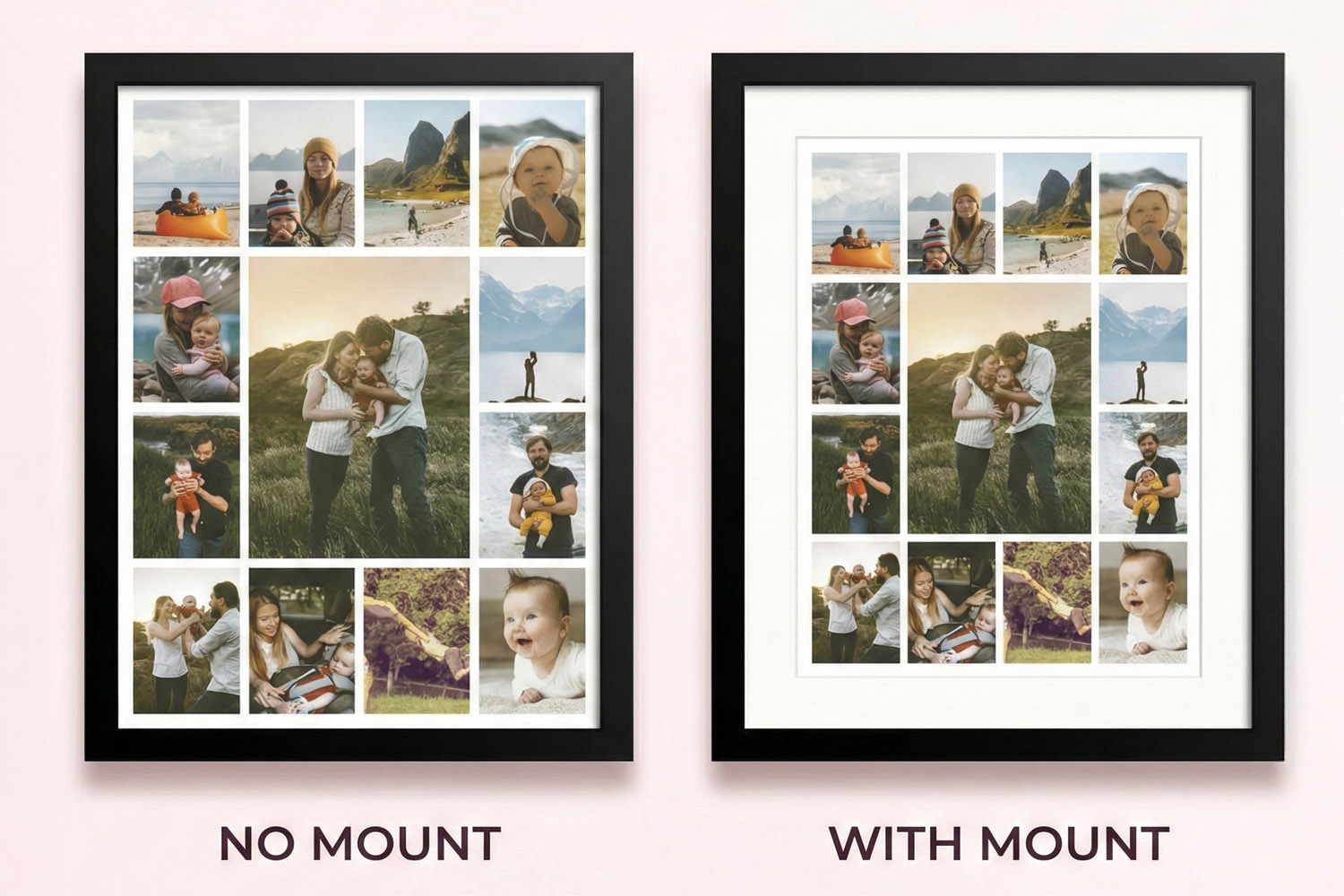
Mount vs No Mount: Why a Card Mount Improves the Look of Your Framed Print
Discover how choosing a card mount for your framed print can enhance its appearance, provide a professional gallery-style finish, and protect your photo over time. Learn when to use a mount versus no mount and explore framing options.
Understanding Acrylic Glazing: Why It’s Safer and Clearer Than Traditional Glass
Discover the benefits of acrylic glazing for picture frames, including its shatterproof safety, lightweight design, and crystal-clear viewing. Learn why acrylic is a practical, family-friendly alternative to traditional glass for displaying your favourite photos at home.

Stay Inspired with Us
Framed and mounted photo prints are stunning additions to any home. Explore our blog for tips on selecting the best images, frame styles, and creating wall displays that make an impact.